
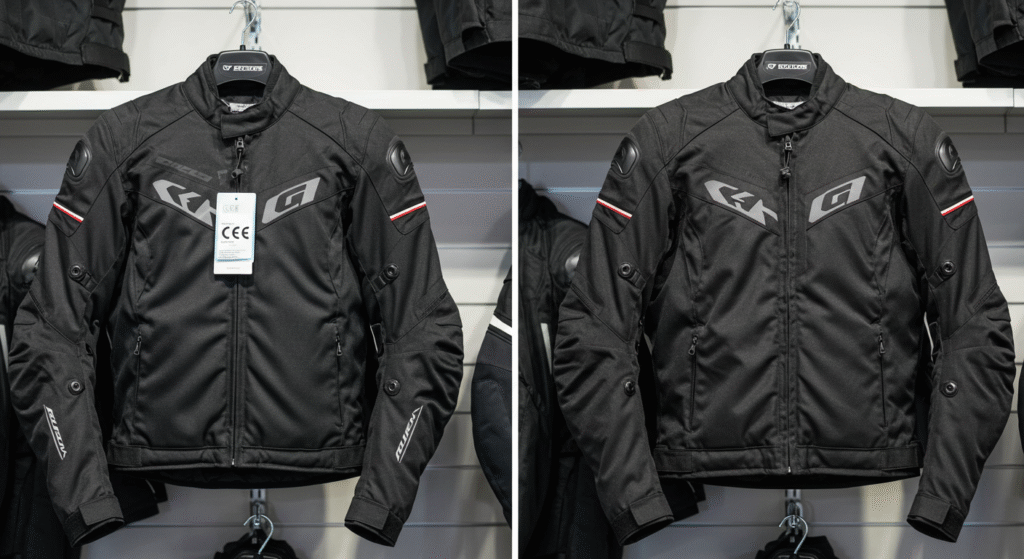
CE Approved Motorcycle Gear: What to Avoid and Why
CE Approved Motorcycle Gear: What to Check Before You Buy
When you shop for CE approved motorcycle gear, check what the claim covers. A jacket can come with CE-marked elbow protectors while the listing tells you very little about the jacket itself. A pair of gloves can look substantial in photos, yet its description may leave out the standard it was tested against. Those details matter more than a bold CE graphic in a product listing.
Start with the exact model, the relevant motorcycle standard and the class or level where one applies. Then check that the manufacturer’s documentation covers the same item. You can do most of this before you spend anything, even if you’re shopping online.
What Does CE Approved Motorcycle Gear Mean?
“CE approved motorcycle gear” is a common shopping term. The formal term you’ll see in manufacturer documents is CE marking. For personal protective equipment, the mark indicates that the manufacturer declares the product conforms to the applicable requirements. The conformity assessment process depends on the type of equipment and the risks it is designed to address.
Product pages may use “CE approved” and “CE certified” interchangeably. When you compare CE approved motorcycle gear, look past that wording to the model identifier, the standard and the manufacturer’s Declaration of Conformity. The declaration should accompany the PPE or the manufacturer should tell you where to find it. Match the document to the exact product or range of models it covers.
In Great Britain, businesses can use CE or UKCA marking for PPE under the applicable rules. If you see UKCA on a product, look for the relevant declaration and performance details in the same way. The marking relates to conformity, while the class helps you understand the performance requirements met by the gear.
How to Verify CE Approved Motorcycle Gear Online
Ask the seller for a clear photograph of the actual label or product markings and a link to the Declaration of Conformity. If the listing bundles a jacket with a separate back protector, ask which documents cover the jacket and which cover the insert. This makes it easier to check exactly what’s in the box.
Use this checklist when comparing CE approved motorcycle gear:
- Identify the model. Match the product name or model code in the listing to the label and documentation. Some declarations cover several models, so check that yours is included.
- Check the standard. Look for a motorcycle-specific standard for the item you’re buying. A standard for limb protectors tells you about the inserts. A garment standard tells you about the clothing they sit inside.
- Read the class or level. Write down which rating belongs to which item. A Class AA jacket and Level 2 elbow protectors describe two different parts of the same purchase.
- Find out what’s included. Check whether the armour is supplied, which areas it covers and what you’d need to buy separately. A back protector pocket may come empty.
- Compare the paperwork with the listing. If the listing says AAA and the label says AA, ask the seller to confirm which model they’ll send and provide the matching document before you order.
A photo of the CE mark alone leaves most of these questions open. If a listing for CE approved motorcycle gear gives you only a logo and a generic product name, ask for the model-specific details before you treat it as protective equipment.
What to Avoid When Buying CE Approved Motorcycle Gear
Listings that give a rating for the pads alone
A jacket advertised with “Level 2 protection” may be describing its shoulder and elbow armour. The inserts have their own job in an impact. The garment has separate performance requirements, including how its materials and seams hold up in testing. Ask for the garment class as well as the armour levels, especially when a seller uses one rating across the entire listing.
Vague phrases and documents for a different model
Phrases such as “CE-style padding”, “rider-grade protection” and “reinforced for safety” give you little to compare. The same applies to a certificate that names a different product. When checking CE approved motorcycle gear, ask whether the seller can point to a declaration or label that identifies the exact model you’re considering. A brand logo on the paperwork is only the beginning of that check.
Claims based on fabric, thickness or lining alone
A lightweight textile jacket can meet a motorcycle garment standard, and a heavy leather jacket made for casual wear may have no stated motorcycle rating. Riding jeans can also use different constructions. Some have a separate reinforcing liner, while others use a protective fabric in a single-layer construction. Compare the finished garment’s class and the supplied protectors before drawing conclusions from how thick it feels or what the fabric is called.
Which Standards Apply to CE Approved Motorcycle Gear?
When you compare CE approved motorcycle gear across categories, use the standard for each item. A Level 2 glove and a Level 2 back protector are tested for different jobs.
| Gear | Standard to look for | What to check |
|---|---|---|
| Jackets, trousers and riding suits | EN 17092 | The class of the complete garment and which protectors are supplied |
| Shoulder, elbow, knee and hip protectors | EN 1621-1 | The body area covered and the level of the insert |
| Back protectors | EN 1621-2 | The level, coverage and compatibility with the jacket pocket |
| Chest protectors | EN 1621-3 | The type, fit and level marked for that protector |
| Motorcycle gloves | EN 13594 | The performance level, wrist closure and stated knuckle impact protection |
| Motorcycle boots | EN 13634 | The performance markings and any separately tested features you want |
Jackets and riding jeans
EN 17092 garment classes include A, AA and AAA. Of those three, AAA has the most demanding requirements, followed by AA and A. Classes B and C cover more specific types of equipment. Class B provides abrasion protection equivalent to Class A without impact protectors included. Class C equipment is designed to provide impact protection in the areas covered by its protectors and is intended to supplement another protective garment.
When shopping for CE approved motorcycle gear such as riding jeans, check how the knee protectors sit when you bend your legs on the bike. A pair that feels comfortable standing up can pull the protectors away from the knees in the saddle. For a jacket, do the equivalent check with your hands positioned as they would be on the handlebars.
Gloves and boots
EN 13594 covers motorcycle gloves and includes tests such as wrist restraint, seam strength and palm abrasion resistance. Level 1 gloves can meet the standard with or without tested knuckle impact protection. Level 2 gloves require it. If you want tested knuckle protection, look at the marking and the manufacturer’s instructions, then close the wrist strap and see whether you can comfortably operate the controls.
For boots, EN 13634 includes requirements such as abrasion resistance, impact cut resistance and transverse rigidity. Some features, such as resistance to water penetration or impact protection at the ankle, can be tested separately. Check the markings for the features you care about, then try the boots in a position that lets you judge how easily you can use the gear lever and rear brake.
Back, chest and limb armour
For limb and back protectors, Level 2 has a stricter limit on transmitted force than Level 1. Chest protectors have their own criteria, including how the protector distributes impact force at Level 2. If you’re adding an insert to CE approved motorcycle gear you already own, use the dimensions and shape recommended for the pocket. Check that the insert sits flat, stays in position and lets you move comfortably with the jacket fully fastened.
Check the Fit Before You Commit
Once you’ve narrowed down the CE approved motorcycle gear you’re considering, try the pieces together. Sit on the parked bike if you can. Bend your arms and legs, reach for the bars and turn your head as you would for a shoulder check. See whether the protectors stay over the right areas and whether the cuffs, waist and ankle openings stay secure.
If you’re comparing denim options, our men’s Kevlar® motorcycle jeans use 12 oz cotton denim, with Kevlar® reinforcement at the seat and removable CE Level 1 knee and hip protectors. The Level 1 rating applies to the protectors. Check the product page for the jeans’ construction and sizing, or visit GHC Sportswear Retail for an overview.
The simplest way to compare CE approved motorcycle gear is to check the exact model, match the standard and rating to the part of the kit they cover, and see how everything fits in the riding position. If a seller can’t tell you what the claim covers, move on to a listing that gives you enough information to make the comparison.
Follow GHC Sportswear Retail on Facebook and Instagram.
Stay smart. Stay protected. Ride with GHC.