
Motorcycle CE Ratings Made Simple for Riders
Motorcycle CE Ratings Explained for UK Riders
Motorcycle CE ratings tell you which protection requirements your riding kit has met. The letters on a jacket label describe the garment’s class, while Level 1 or Level 2 on a knee protector describes its impact performance. Once you know which rating applies to which part of your kit, comparing products becomes much easier.
For example, a jacket can be Class AA and include Level 1 elbow and shoulder armour. Both ratings belong in its description because they cover different aspects of protection. Before you buy, check the garment label, the markings on the protectors and the manufacturer’s information for the exact model.
What Are Motorcycle CE Ratings?
CE stands for Conformité Européenne, meaning European Conformity. On personal protective equipment, CE marking indicates that the manufacturer declares conformity with the applicable requirements after the relevant assessment process.
The phrase “motorcycle CE ratings” usually refers to the classes and performance levels shown alongside the mark. These give you more detail about the item’s tested performance. A clothing class can cover requirements for abrasion resistance, seams and other parts of its construction. An armour level describes performance in an impact test.
The results relate to specified laboratory tests. Road surfaces, impact angles, fit and the way a rider falls all affect what happens in a crash. Use the rating to compare tested performance, then check whether the gear fits securely and works with the rest of your kit.
Motorcycle CE Ratings for Jackets, Trousers and Suits
EN 17092 covers protective motorcycle garments. The series includes test methods and requirements for five garment classes. The tests assess several features of the clothing, including abrasion resistance, tear strength, seams and closures.
When reading motorcycle CE ratings on clothing, look for both the standard number and the class. A product page that lists the two together gives you a useful starting point for comparing similar garments.
| Garment class | Standard reference | What the class covers |
|---|---|---|
| AAA | EN 17092-2 | The most demanding requirements among the A, AA and AAA classes |
| AA | EN 17092-3 | Requirements above Class A and below Class AAA |
| A | EN 17092-4 | Lower performance requirements than AA and AAA |
| B | EN 17092-5 | Abrasion protection equivalent to Class A, without impact protectors included |
| C | EN 17092-6 | Impact protection in the areas covered by the protectors, intended to supplement other protective clothing |
How to compare A, AA and AAA
AAA is the highest of these three classes, but the letters describe performance requirements across the garment. The material name alone gives you much less information. Leather, textile and protective denim garments can meet different classes depending on their design and construction.
A rider might compare an AA jacket with an AAA alternative and find that one is easier to move in or has better ventilation. Check the fit and features of the actual products. Motorcycle CE ratings let you compare their tested classes while you judge how each one feels in the riding position.
What to know about Classes B and C
Class B clothing provides abrasion protection equivalent to Class A without impact protectors included. You need to consider suitable impact protection separately.
Class C equipment provides impact protection where its protectors cover the body. It has no minimum abrasion protection requirement and is intended to supplement other protective clothing. Read the manufacturer’s instructions to understand how the item should be worn and what it should be paired with.
Motorcycle CE Ratings for Armour
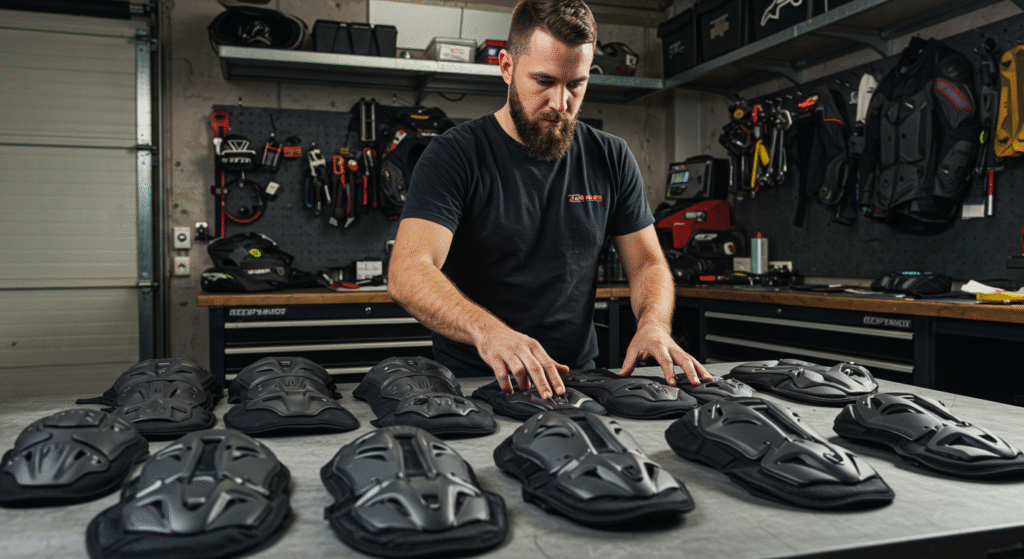
The EN 1621 series covers impact protectors. Different parts of the series apply to different areas of the body, so check the standard as well as the level.
| Standard | Protector type | Details to check |
|---|---|---|
| EN 1621-1 | Shoulder, elbow, knee and hip protectors | The body area, coverage and performance level |
| EN 1621-2 | Back protectors | Coverage type, sizing and performance level |
| EN 1621-3 | Chest protectors | Design, coverage and performance level |
With motorcycle CE ratings for limb and back armour, Level 2 has stricter transmitted-force limits than Level 1. That means less force is allowed through the protector in the relevant test. Fit and coverage still matter, especially when you add a new insert to an existing jacket or pair of trousers.
Why the force figures differ
A force figure you’ve seen for a back protector should be compared with other back protectors tested under that standard. Limb protectors have different limits.
The following table shows the mean transmitted-force limits for limb and back protectors. Lower transmitted force means less force passes through during the test.
| Protector type | Level 1 mean limit | Level 2 mean limit |
|---|---|---|
| Limb protectors under EN 1621-1 | 35 kN | 20 kN |
| Back protectors under EN 1621-2 | 18 kN | 9 kN |
The standards also set limits for individual impacts. The figures above describe the average across the specified tests. Each strike must also meet the applicable individual limit. These figures are useful when reading motorcycle CE ratings, provided you compare the same type of protector.
Chest protectors have their own criteria. Under EN 1621-3, Level 2 includes requirements for distributing impact force as well as transmitting it. Check the manufacturer’s explanation for the particular chest protector you’re considering.
Check where the armour sits
Try a jacket with your arms bent towards the handlebars. The elbow protectors should cover your elbows and stay in position as you move. Do the equivalent check for knee protectors while seated with your knees bent.
If you’re buying a back protector separately, use the size and shape specified for the jacket pocket. A larger insert may sit awkwardly or affect the jacket’s fit. When comparing motorcycle CE ratings, check the coverage and how securely the protector stays in place alongside its level.
How to Read Motorcycle CE Ratings on a Label
Consider a clothing label marked EN 17092-3:2020, Class AA. Each part of that reference has a purpose.
| Label detail | Meaning |
|---|---|
| EN 17092 | The standard series for protective motorcycle garments |
| -3 | Part 3, which sets the requirements for Class AA garments |
| 2020 | The publication year of that edition of the standard |
| Class AA | The garment’s protection class |
The part number matters. EN 17092-2 applies to AAA garments, while EN 17092-3 applies to AA garments. The year in the reference identifies the edition of the standard.
An insert marked EN 1621-1:2012, Level 2 refers to a limb joint impact protector. Check the accompanying body-area and size markings to see where it should be used. To understand the motorcycle CE ratings for the whole purchase, read the jacket or trouser label as well as the inserts.
What About Gloves and Motorcycle Boots?
Gloves and boots have their own motorcycle standards. You’ll usually look for EN 13594 on protective gloves and EN 13634 on protective motorcycle footwear.
EN 13594 includes requirements covering features such as palm abrasion resistance, seams and wrist restraint. Gloves have Level 1 or Level 2 performance classifications. Knuckle impact protection is optional for Level 1 and required for Level 2. Look for the relevant marking and read the instructions if tested knuckle protection is a feature you want.
Boots use performance markings for several features. These include abrasion resistance, impact cut resistance and transverse rigidity. Some properties, such as water resistance and impact protection at the ankle, have additional tests. Ask the seller to explain the markings for the exact model if the listing leaves them unclear.
Using Motorcycle CE Ratings When Choosing Your Kit
Start by choosing the garment class and armour coverage you want, then try the kit in your usual riding position. Fasten the cuffs, waist and other adjusters, and see whether you can reach the controls and turn your head comfortably. Check the overlap between the jacket and trousers when you lean forward.
For commuting and touring, compare ventilation, waterproofing and room for layers alongside the protection information. If you ride in very different seasons, try the jacket with your usual summer and winter layers so you can see whether the protectors stay secure in both.
For track use, check the organiser’s equipment rules before booking. Requirements can cover the suit construction, connections between garments and additional protection. Motorcycle CE ratings are one part of the information you’ll need when checking whether your kit meets those rules.
If you’re buying online, ask for the manufacturer’s Declaration of Conformity or a link to it. Match the model name or code to the item in your basket. This is especially helpful when several generations of a product use similar names.
CE Marking, UKCA and Product Descriptions
In Great Britain, PPE can be placed on the market using either CE or UKCA marking under the applicable rules. Whichever route the manufacturer uses, look for the product’s standard, performance details and supporting declaration.
Descriptions such as “CE approved” and “CE certified” are often used in product listings. The documents and markings for the exact model give you the detail needed to assess the claim. When checking motorcycle CE ratings, write down the garment class and the armour levels separately so you can compare like for like.
Check the Details on Your Riding Jeans
For riding jeans, check the garment information, where the reinforcement sits and which knee and hip protectors are supplied. Some designs use a reinforcing liner, while others use a protective fabric in a single-layer construction. The finished garment’s class is the useful point of comparison.
Our men’s Kevlar® motorcycle jeans use 12 oz cotton denim, with Kevlar® reinforcement at the seat and removable CE Level 1 knee and hip protectors. The Level 1 description applies to the protectors. Check the product information for the garment’s certification details, construction and sizing.
You can also visit GHC Sportswear Retail to see the jeans’ features and colour options. When you receive your kit, keep the supplied information and check that the protectors sit over the right areas with everything fastened.
Follow GHC Sportswear Retail on Facebook and Instagram.
Ride smart. Gear up. Know your CE.
Written by the GHC Sportswear Team
Trusted by riders who want protection without the blah.