Motorcycle Safety at Roundabouts: You’re Not Valentino Rossi, Slow Down and Survive
Motorcycle Safety at Roundabouts: A UK Rider’s Guide
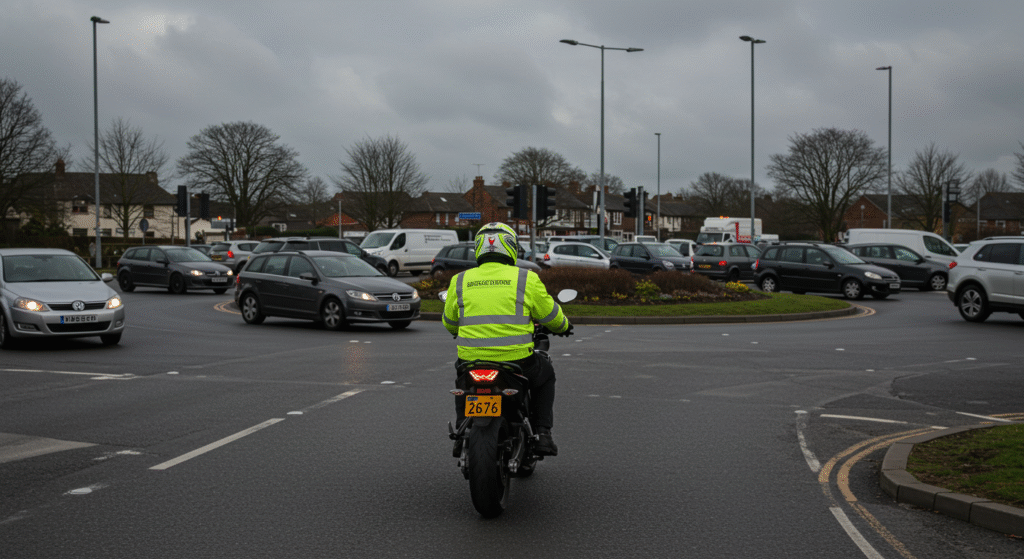
Motorcycle safety at roundabouts starts on the approach. Read the signs, choose the lane for your exit and slow down early enough to stop if you need to. At the entry, give priority to traffic coming from your right unless signs, markings or lights direct you otherwise. Look forward before moving so you know the vehicle ahead has actually gone.
Once you join, follow the lane markings, give cyclists and larger vehicles room, and signal clearly before leaving. A familiar roundabout can feel different in heavy traffic or rain. Give yourself enough time to read what is happening on this approach.
Motorcycle Safety at Roundabouts Starts on the Approach
Look for the junction sign while you still have time to read it. Identify your exit and check the arrows on the road as you get closer. At a busy junction, a lane may serve more than one exit, or markings may guide you out of the roundabout in a particular lane. Follow the layout in front of you.
Check your mirrors and ease your speed before the entry. Choose a speed that gives you enough room to stop at the line if the gap closes or the vehicle ahead waits. The approach can tell you a lot about what you will need to do next. A queue at the exit, a lorry covering part of your view or a cyclist near the kerb all give you reasons to allow more space.
For motorcycle safety at roundabouts, start looking early enough to take in both the traffic ahead and the traffic on your right. If you are following a car to the line, watch it again before you move. The driver may have started to go and then stopped when they saw another vehicle.
Motorcycle Safety at Roundabouts When Judging a Gap
Give priority to traffic approaching from your right unless the junction directs you otherwise. If road markings let you join without giving way, still check to your right before entering. At a roundabout controlled by lights, follow the signals and continue to check the traffic around you.
An indicator is one piece of information. Also look at the vehicle’s position, speed and direction. If a car is signalling left but its path is still unclear, wait until you can see where it is going. Judge whether you have time to enter smoothly without making other traffic brake or change direction.
Motorcycle safety at roundabouts depends on judging the gap for your own bike. If the rider ahead gets through, check again before following. The gap may have changed, and the driver approaching from the right may already be responding to the first motorcycle.
Lane Choice and Signals for Motorcycle Safety at Roundabouts
Use the signs and lane markings first. Where they give no different instructions, the Highway Code’s usual approach is as follows.
| Exit | Approach | Leaving the roundabout |
|---|---|---|
| First exit to the left | Use the left lane and indicate left. | Keep left and maintain the left signal as you leave. |
| Intermediate exit | Choose the lane that serves your exit. An approach signal is usually unnecessary. | Hold your lane until you need to move to leave. Indicate left once you pass the preceding exit. |
| Exit to the right or full circle | Use the right lane and indicate right. | Stay right until it is time to move out safely. Indicate left once you pass the preceding exit. |
If you need to move across a lane, check your mirrors and the relevant blind spot when safe. Give other road users time to see your signal. If the gap is gone or you have missed the exit, follow a lane or exit the markings allow and reroute from there. A late cut across another lane gives everyone less time to react.
Motorcycle safety at roundabouts also means looking beyond the exit itself. Be ready for a queue, a cyclist continuing around the junction or people crossing the road you are about to enter. See the Highway Code roundabout rules.
Motorcycle Safety at Roundabouts in Rain and Mixed Traffic
On a wet approach, slow earlier and leave more room in front. Spray can make markings and other road users harder to see. Watch for surface changes, including wet painted lines, metal covers, loose material and possible diesel spills. Reading the surface early gives you more time to adjust your speed and position smoothly.
Give cyclists and larger vehicles room
A cyclist in the left lane may be continuing around the roundabout. In Great Britain, the Highway Code advises giving cyclists priority on the roundabout. Leave room for them to cross your path. Wait behind if passing would put you alongside them in the same lane. Look again before taking an exit that crosses their route.
A long vehicle may need more than one lane to get around. Watch its signals and the direction it is actually moving, and leave it room to turn. A space beside a lorry can close as the vehicle follows the curve, so let it clear the junction when you are unsure how much room it needs.
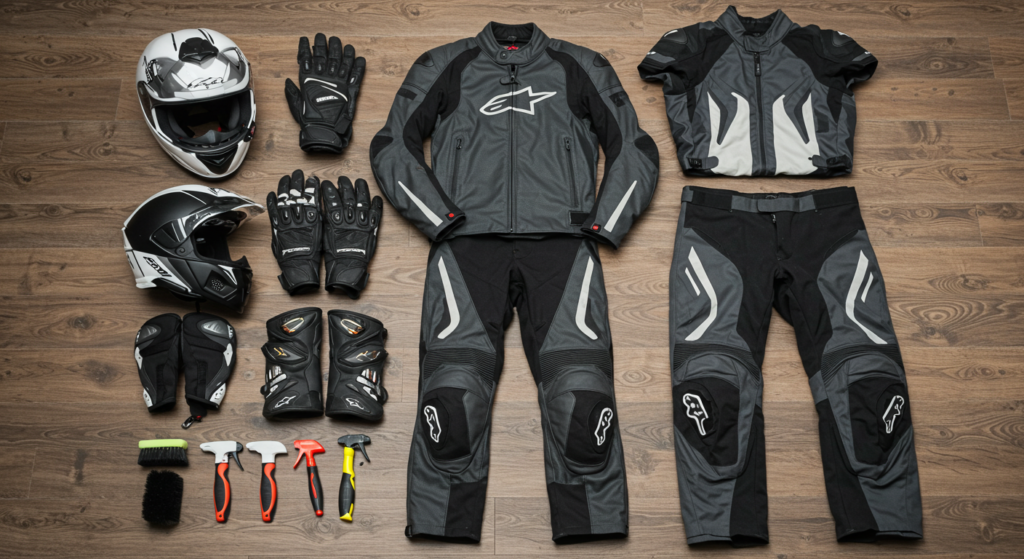
For motorcycle safety at roundabouts, a clear visor and gear that lets you turn your head comfortably help you make those observations. Check your visor before leaving and take extra care when rain or glare makes the junction harder to read.
How to Ride Through a Mini-Roundabout
Approach a mini-roundabout with the same attention to priority, markings and signals as a larger one. Ride around the central marking. The smaller space gives you less time to read another vehicle’s path, so arrive at a speed that lets you wait if needed.
At a double mini-roundabout, treat each one as a separate junction. After clearing the first, check again for traffic from the right at the second. The gap you used to enter the first junction tells you little about what is happening at the next one.
Practise Motorcycle Safety at Roundabouts on Familiar Roads
If one junction regularly catches you out, work out which part is causing difficulty. It might be reading the lane arrows early enough, seeing past a larger vehicle or knowing when to signal. A qualified instructor can help you work through the layout and give feedback on your approach and observations.
In Great Britain, the DVSA enhanced rider scheme offers assessment and training for riders with a full motorcycle licence. The syllabus covers urban riding, including observation, junctions and roundabouts. See the DVSA enhanced rider scheme.
Set your kit up for the riding position you actually use. Our men’s Kevlar® motorcycle jeans at GHC Sportswear™ Retail use 12 oz cotton denim, Kevlar® reinforcement at the seat and removable CE Level 1 knee and hip protectors. Stretch panels at the knees and waist help accommodate the riding position. Check the fit with your feet on the pegs so you can see where the armour sits when your knees are bent.
To practise motorcycle safety at roundabouts, pick a familiar junction and notice how early you can identify your lane and exit. That small habit gives you more time to judge the gap when you reach the entry.
Follow GHC Sportswear™ Retail on Facebook and Instagram.
Ride smart. Gear up. Know your CE.
Written by the GHC Sportswear™ Retail Team
Trusted by riders who want protection without the blah.