Motorcycle Tattoos: Symbols, Meanings, and Superstitions
Motorcycle Tattoos — 7 Symbols and What They Can Mean
A tattoo of a motorcycle can recall a first bike, a road you used to take with a friend or years spent restoring a machine. Even two riders with the same skull or eagle design may have chosen it for different reasons. Some motorcycle tattoos draw on familiar imagery. Others only make sense once you hear the story behind them.
The most useful way to understand motorcycle tattoos is to start with the rider’s own account. A wing can suggest freedom or remembrance. A date might mark a first tour or the loss of someone close. The details around the design often tell you more than the symbol on its own.
What Motorcycle Tattoos Can Say About a Rider
Motorcycle tattoos give people a way to record a part of their lives that might be hard to describe in words. A café racer outline might bring to mind the bike someone built from a box of parts. A tiny drawing of a key could mark the day they passed their test. Someone who rides the same road every Sunday may have just as much reason to remember it as someone who has crossed a continent.
There’s a wider history of people using tattoos to mark work, travel and belonging. The American Swedish Historical Museum included sailors and motorcycle groups in its exhibition on tattoo identity. Riders also draw inspiration from different biker subcultures, so it’s worth asking where an image came from before assuming it has a shared meaning.
Seven Symbols in Motorcycle Tattoos and What They Can Mean
1. Skulls and reminders of mortality
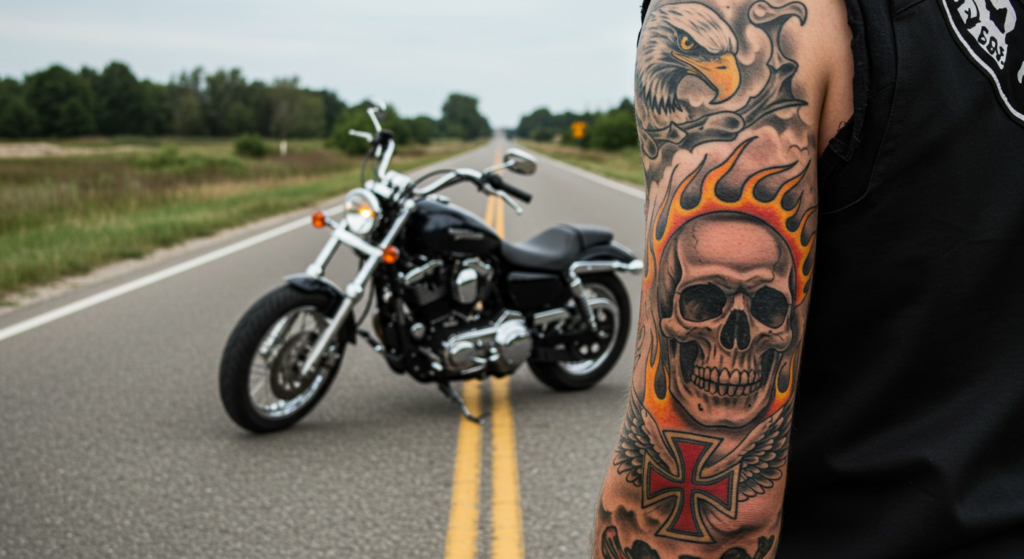
In motorcycle tattoos, a skull can mark an awareness of risk, remember someone who died or simply reflect a taste for bold traditional artwork. There’s a much older precedent for using skulls to remember the dead or reflect on the fragility of life. The Science Museum Group holds a nineteenth-century memento mori skull made to express those ideas.
The accompanying details make a difference. A skull with a date and initials can be part of a tribute. A skull drawn on its own might appeal for its strong outline. If the conversation naturally turns to the tattoo, ask the rider what drew them to the design.
2. Eagles and independence
Eagles in motorcycle tattoos can suggest freedom, strength or an interest in American motorcycle imagery. A bald eagle can also carry a specifically American association because it appears on the Great Seal of the United States. A bird in flight over a ridge may simply recall the sense of space someone felt on a particular ride.
The shape matters when you’re planning a design. An eagle with spread wings needs room for the outline to read clearly. If the story is about a particular place, bring the artist a photo of the landscape. A recognisable ridge or road can make the image more personal.
3. Wings and the feeling of movement
Motorcycle tattoos can use wings without depicting a bird. A rider might add them to a wheel, a helmet or a name to suggest movement or remembrance. The effect changes with the rest of the design. Wings behind a wheel can give it a sense of motion, while a single wing beside a date may have a quieter meaning for the person wearing it.
An artist can show you whether the wings need to be symmetrical, how much room they’ll occupy and how the lines will sit when you bend your arm. Ask to see the design in the position where you’ll usually see it yourself.
4. Motorcycle silhouettes and engine details
Some of the most personal motorcycle tattoos start with a mechanical detail. The shape of a tank, the angle of a headlamp or an engine casing may be enough to identify a bike you’ve owned for years. A rider who spent weekends restoring an old machine might recognise its outline more readily than its brand logo.
Bring clear reference photos and point out the parts that matter. If you want a small piece, ask the artist which details can be simplified. An accurate silhouette can carry the memory without reproducing every bolt. Choosing one recognisable feature can also make the tattoo easier to read at a distance.
5. Routes, places and milestones
Motorcycle tattoos can mark a journey with a road number, a contour line, a town name or the outline of a familiar mountain pass. The place can be modest. It might be the café you reached on your first solo ride or the stretch of coast where you stopped with someone you’ve since lost touch with.
If you use coordinates, check them against the exact point you want to remember. If the route itself is the subject, ask the artist how much of the map will fit at the size you have in mind. A ferry crossing, a mountain pass or another landmark from a favourite UK motorbike route can give the design a clear focal point.
6. Helmets, initials and memorial designs
Memorial motorcycle tattoos often use an object the rider’s friends would recognise. That might be a helmet with a distinctive stripe, a set of keys or a phrase the person always used before leaving. Initials and dates can add context, although some people prefer to keep the meaning private.
If several friends want a matching design, take time to agree on details that matter to all of you. Check dates and spelling against a reliable record before the appointment. A tattoo is one way to remember a riding companion. Others may prefer to gather at a familiar place, as people sometimes do on memorial rides.
7. Gremlin bells and other lucky charms
A rider who carries a gremlin bell might choose to turn it into a tattoo. Also called a guardian or ride bell, it comes from motorcycle folklore and is often given as a token of friendship. The appeal may be the memory of the person who gave it to you. Harley-Davidson describes the gift tradition in its guide to motorcycle ride bells.
Other motorcycle tattoos use a coin, a guardian figure or a keepsake with similar personal meaning. A design that recalls someone who wished you well before a long trip can carry the same significance as a keepsake you carry on the bike. Both draw on the traditions behind riders’ pre-ride rituals.
Club Insignia and the Iron Cross in Motorcycle Tattoos
Club emblems, names and distinctive arrangements of lettering can communicate a specific affiliation. An image that looks decorative on a reference board may be recognised as a club design by local riders. If you admire the composition, tell the artist what you like about it and ask for a version built around your own bike, route or story. Clothing and tattoos can lead to quick assumptions about who belongs, a subject we explore in our article on gatekeeping in motorcycling.
The Iron Cross needs particular historical context. It predates the Nazi regime as a German military decoration, and the National Army Museum holds a First World War example. The Nazi-era version added a swastika. The Anti-Defamation League documents the symbol’s later use by white supremacists and its adoption in some American biker and other subcultures. The exact design and surrounding imagery matter when interpreting an Iron Cross.
That history makes a general label such as loyalty too broad. If the idea you want to express is commitment to friends or to a club, a shared destination, a date or a detail from a bike you worked on together can express it more clearly. Ask the artist about any motif whose origin you’re unsure of before it becomes part of the design.
Choosing Motorcycle Tattoos That Fit Your Story
Start by writing down what you want to remember. A useful brief can be a single sentence, such as ‘the first bike I rebuilt with my dad’ or ‘the road my friend and I rode every summer’. Bring two or three photographs with a note about what matters in each. An artist can use those details to suggest a composition that fits the part of the body you have in mind.
Motorcycle tattoos can be small and subtle or large enough to hold a full scene. Ask to see a stencil at the intended size and check it in a mirror, both with your arm relaxed and in motion if relevant. For lettering, check the spelling, punctuation and legibility. Look for healed motorcycle tattoos or similar work in the artist’s portfolio so you can see how small details read after the initial session.
If you’re booking in England or Wales, ask the studio about its local council registration or licence. Discuss hygiene and written aftercare before the appointment. Tell the artist where your jacket cuffs, armour or boots sit so you can plan the appointment around when you need to ride. If the aftercare instructions conflict with wearing your usual protective riding gear, arrange another way to travel while the area heals. The government provides tattoo licensing guidance for England and Wales and infection prevention guidance for England.
The Story You’ll Still Want to Tell
Motorcycle tattoos can preserve details that tend to disappear from a photograph. The outline of a dented tank may bring back the afternoon you got an old engine running. A road number may be all you need to remember where you were headed and who was beside you. If you can tell the artist why that detail matters, you’ve given them a clear starting point for a design you’ll recognise as your own.
Follow GHC Sportswear™ Retail on Facebook and Instagram.
Ride smart. Gear up. Know your CE.
Written by the GHC Sportswear™ Retail Team
Trusted by riders who want protection without the blah.