Kevlar Motorcycle Jeans: The Best Protection Regular Denim Can’t Offer
Kevlar Motorcycle Jeans vs Regular Denim — What Changes on the Bike?
From a distance, a pair of riding jeans can look much like the denim you wear to work or to the shops. Put both pairs on a table and the differences become clearer. One may have reinforcement under the outer fabric, pockets that hold impact protectors and a label that tells you what the garment was tested to do.
The comparison between Kevlar motorcycle jeans and regular denim comes down to those details. The fibre name tells you something about the material. The construction, armour and garment class tell you more about the pair you’re considering. Fit matters too, because you’ll spend much of the ride with your knees bent and your feet on the pegs.
Kevlar Motorcycle Jeans and Regular Denim at a Glance
Regular denim is made for everyday wear. Kevlar motorcycle jeans are designed around the movements and hazards of riding, with features that vary by model. Compare the two finished garments and check what comes with the jeans as well as what the listing says about the fabric.
| Feature | Regular denim | Kevlar motorcycle jeans |
|---|---|---|
| Fabric | Denim chosen for appearance, comfort and everyday wear. | Denim with Kevlar® reinforcement or a fabric blend, depending on the design. |
| Seams and closures | Built for ordinary use. | Assessed for strength when the garment is tested to the relevant protective clothing standard. |
| Impact protection | Typically sold without knee or hip protectors. | Armour may be supplied or available separately. |
| Fit | Usually assessed standing or walking. | Check coverage, movement and protector position while seated. |
| Documentation | A care label and fibre composition. | Look for a protective garment standard and class, plus separate markings on the armour. |
Five Practical Benefits to Look for in Kevlar Motorcycle Jeans
1. Reinforcement that can improve abrasion resistance
When a rider slides, the road can wear through clothing. Kevlar® is DuPont’s brand of para-aramid fibre. In motorcycle clothing, manufacturers can use it in thread, in a fabric blend or in a layer beneath the denim. It can improve resistance to abrasion and tearing where it is used. DuPont explains these applications in its motorcycle apparel guide.
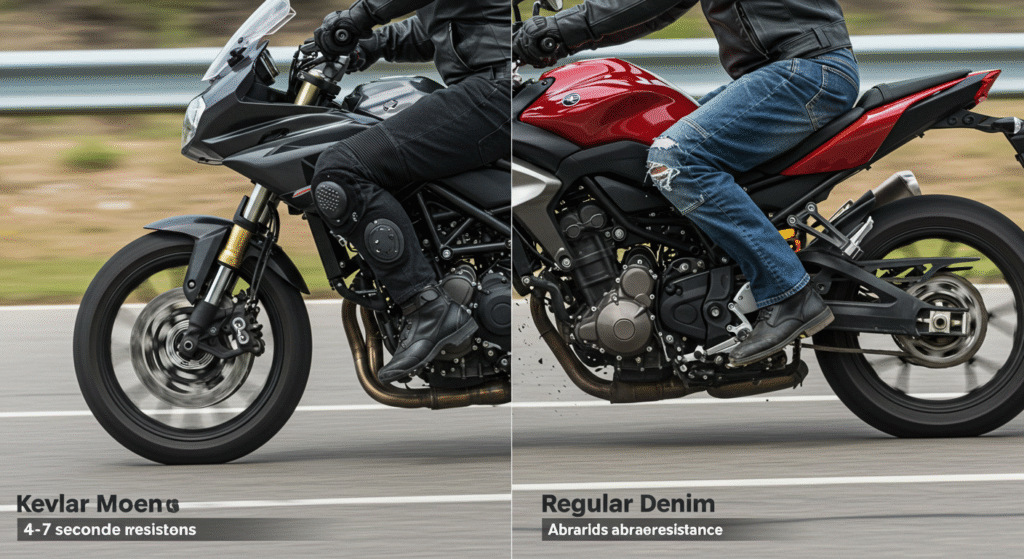
The difference a layer can make shows up in MotoCAP’s abrasion tests. Using the EN 13595-2:2002 lab method, the denim sample took an average of 0.52 seconds to develop a hole. With a comfort mesh liner, it took 0.78 seconds. With a para-aramid layer and the mesh liner, it took 3.25 seconds.
Those results describe how specific fabric samples performed on a test machine. On the road, the surface, the point of impact and the way the garment moves all affect what happens. When comparing Kevlar motorcycle jeans, ask whether the reinforcement sits beneath selected areas or forms part of a larger panel or the outer fabric.
You may also see fibre-strength claims in adverts for Kevlar motorcycle jeans. Tensile strength describes how a fibre responds when pulled. Abrasion testing measures how a material wears against a surface. For a comparison between riding trousers, start with the finished garment’s documentation, which accounts for more than the fibre in one part of it.
2. Seams and fastenings designed for a protective garment
If a seam opens or a fastening gives way during a fall, the fabric can shift and leave skin exposed. Double stitching can be a feature of a strong seam, but the number of visible rows tells you little about its strength on its own. The fabric, thread and way the layers are joined all matter.
When looking at Kevlar motorcycle jeans, check how the waistband closes and whether the inside seams and armour pockets are neatly finished. Then check the documentation for the finished pair. SATRA explains how the EN 17092 garment tests assess seams, fasteners and protector pockets alongside the fabric.
3. Knee and hip impact protection
Denim and armour serve different purposes in a fall. The fabric forms a barrier against the road surface, while an impact protector is designed to reduce the force transmitted at the area it covers. When buying Kevlar motorcycle jeans, check which pads come with the pair, where they sit and whether they’re removable.
Under EN 1621-1, Level 2 limb-joint protectors have a lower permitted limit for transmitted force than Level 1 protectors. Either level still needs to fit the wearer and the intended pocket. If a listing mentions CE Level 1, check which pads that level applies to. The garment class is a separate marking, as our guide to motorcycle CE ratings explains.
Crash research provides a different kind of evidence. In an observational study of 212 motorcyclists who had crashed, those wearing motorcycle trousers were less likely to be admitted to hospital. The researchers assessed riding trousers as a category, so the results describe an association across riders wearing different gear.
4. A cut that works in the riding position
Most people try on everyday jeans standing up. For Kevlar motorcycle jeans, sit with your knees bent as they would be on the bike. Check that the waistband stays in place, the hems still meet your boots and the pads remain centred where the manufacturer intends. Walk around afterwards to see whether you’d be comfortable keeping the jeans on after you park.
If the protectors have adjustable positions, try those before moving up or down a size. An inside-leg length that looks right when you’re standing may leave a gap above your boots once your knees are bent. Take your boots with you if you’re trying the jeans on in a shop. Our guide to riding jeans and abrasion covers more checks for how the pieces fit together.
5. A way to compare protection across products
Kevlar motorcycle jeans can have different garment classes even when they look similar or use the same fibre. If the model is certified to EN 17092, look for its class on the label or in the maker’s documentation. Classes A, AA and AAA have progressively more demanding requirements. When comparing pairs, use the same standard and check the exact model.
Compare the garment and protector markings separately. If an advert says a garment has armour, find out whether both knee and hip pads are included. If it gives a class, look for a label or document that matches the product you’re ordering. Being able to verify those details is useful when two pairs of Kevlar motorcycle jeans look almost identical in photos.
Can You Wear Kevlar Motorcycle Jeans Off the Bike?
Many pairs are cut to look like everyday denim, so you can leave them on for work, lunch or a walk after parking. Whether you’ll want to depends on the pair. Armour can feel more noticeable at a desk than on the bike, and a heavier lining can feel warm indoors. Try sitting in the jeans for a few minutes with the protectors installed to see if they suit your day.
Check the weather features separately. Some Kevlar motorcycle jeans are wind-resistant, while others have ventilation or a lining for colder conditions. Look at the specification for the actual model if you need waterproofing. If you use waterproof overtrousers, try them over your usual jeans and boots. Make sure you can still bend your knees and that the outer layer doesn’t pull at the hems. Our winter riding guide covers how to layer for colder journeys.
Are Kevlar Motorcycle Jeans Worth Buying?
For regular road riding, it makes sense to budget for trousers made for motorcycling. Compare the total price of a pair you can wear on your usual rides, including any protectors you need to buy separately. A higher price can reflect a different lining, cut or finish. Use the stated protection and the fit to judge whether those features are worth paying for.
If you commute and keep the jeans on at work, you may care most about how the armour feels after an hour at a desk. For longer weekend rides, room for an extra layer or a comfortable fit around the knees may matter more. Think about the journeys you make most often and what you’ll want from the jeans once you arrive.
Before ordering, compare a few details:
- What’s included. Check whether the price covers knee and hip protectors and whether the retailer identifies their level.
- What you can verify. Find the garment class, reinforcement areas and sizing guide for the exact pair of Kevlar motorcycle jeans.
- How you’ll look after them. Read the care instructions and check how to remove and refit the pads. Our gear maintenance guide covers cleaning and inspection between rides.
What GHC Sportswear™ Retail’s Riding Jeans Include
GHC Sportswear™ Retail’s men’s riding jeans have a 12 oz cotton denim outer with Kevlar® reinforcement at the seat. The removable CE Level 1 knee and hip protectors sit in Kevlar® mesh pockets. Stretch panels at the knees and waist help accommodate the seated position. The denim is described as wind-resistant, so plan separate rain protection if you need it.
If you’re deciding between these Kevlar motorcycle jeans and another pair, compare the reinforcement location, included armour and sizing information. Check the garment label or the model’s certification documents for its class. Then try the jeans on with your boots and see how the armour sits with your knees bent.
Regular denim and Kevlar motorcycle jeans may look similar on a hanger. On the bike, the useful differences are how much coverage you keep when you sit down, where the armour rests and what the manufacturer can show about the finished garment. Those are the details to check before you buy.
Follow GHC Sportswear™ Retail on Facebook and Instagram.
Ride smart. Gear up. Know your CE.
Written by the GHC Sportswear™ Retail Team
Trusted by riders who want protection without the blah.